Engineers on their way - Care to join

Screen Shot 2018-07-06 at 17.08.00.png

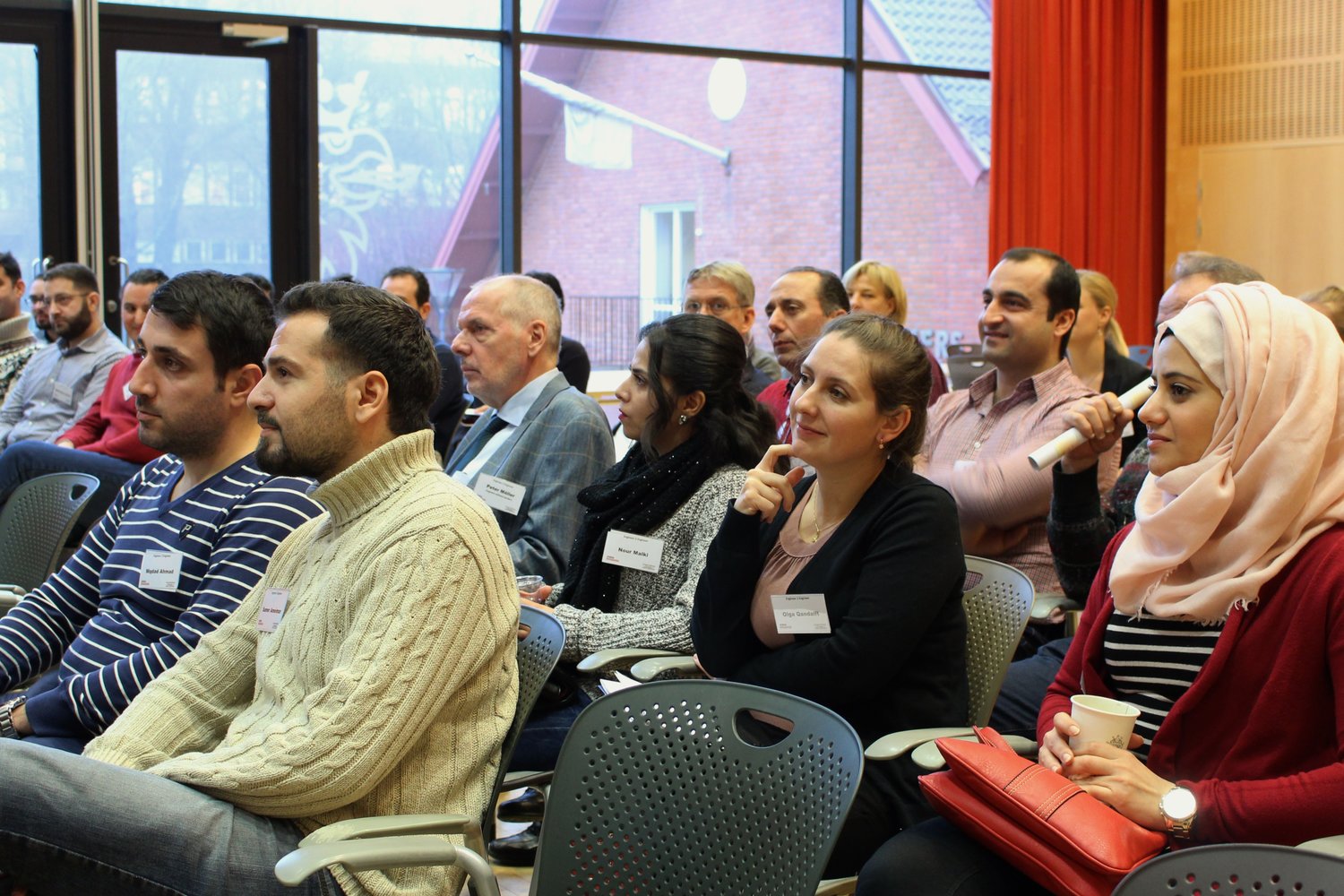
Engineers on their way-Care to join” is an exhibition with the aim to inform and inspire engineering student by showing how engineering skills are needed and used to help refugees. The exhibition has been created with the engineer in mind, presenting five different initiatives in which engineering plays a key role in helping displaced people. For each initiative, the need and the requirements in the specific case are stated, followed by the solution provided by the initiator. By acknowledging different aspects of displacement and by showing a wide spectrum of engineering being applied, the exhibition informs and hopefully inspires engineers, future engineers and others to contribute to a better world.

The exhibition was an initiative from the EWB Linköping where it has also been exhibited during the spring. The exhibition is intended to be long-lived and used elsewhere and will go on a tour to other EWB groups. During the fall, it will be shown at Uppsala University and Chalmers University and the exhibition will hopefully continue to other universities.

DSC00364.JPG

A new rainwater tank for Rukole Primary school in Tanzania was financed through crowdfunding (swish).

Thanks to your donations a rainwater tank is now being built at Rukole Primary School.

The tank will provide drinking water for the over 1300 students. The rainwater tank collects water during the rainy season and provides the school with drinking water during the dry season.  The donated money goes directly to the construction of the tank with local volunteers (some parents of the school children) and local workers. All work by members of Engineers Without Borders is volunteer work. 

r4.jpg
r3.jpg
r.jpg
rukole.jpg

Work as a volunteer for 9 months?
If you have the possibility to work as a volunteer for a long time it will surely be an experience you will never forget. Engineers Without Borders needs experienced engineers in many tasks. To stay abroad as a volunteer for 3-12 months is a good way to use your engineering skills to help others. One of our volunteers, Marianne Grauers is currently staying in Karagwe district in Tanzania for 9 months. There she is working with many different projects like for example providing clean water in villages and schools. If you are interested contact: marianne.grauers@ewb-swe.org


A new chairman and steering group for Engineers Without Borders Sweden

At the annual meeting in April, a partially new steering group was elected and I gained the confidence to lead this work. To our support, we have a Secretary General - Caroline Bastholm, a new role in the organisation. Many exciting challenges lie ahead such as increased support to the local groups, better internal communication and much more.  At the annual meeting surprisingly many, but good motions came in that will be undertaken in the steering group.

An essential task in the coming year is to strengthen our vision work. This together with our guiding principles will be discussed and more strongly incorporated in our work.

The summer is here and with it, we have a lot of activity in our international projects. Many are now in the field to carry out the work that was prepared for during the winter and spring. On the web page there is information about the international projects and but also our other humanitarian engineering projects such as Engineer to Engineer, Openhack, Inspire Youth and much more.

I wish you all a good summer!

Janne Byfors

Revit verification course for newly arrived building engineers

The Engineer to Engineer group in Malmö is happy to announce that we, in cooperation with Malmö University, Region Skåne and Symetri AB, will offer a Revit verification course for newly arrived building engineers.


The course will be held this fall v.33-v.40. After course completion, you will get an Autodesk Revit certification from Symetri AB and a diploma from Malmö University as a reference of your knowledge.

Apply to the course before 2018-06-30, there are limited seats.

Do you have any questions? Please send an e-mail to cadproject.e2emalmo@ewb-swe.org

More information about the course and how to apply is found in the link/attached PDF (text in Swedish):

https://drive.google.com/file/d/1egt3piGtC2_tryWHv_d0PJz7ZDBln1oN/view?usp=sharing

e2e.jpeg
 

Engineer to Engineer (E2E) is an integration project within Engineers Without Borders Sweden. We want to connect newly arrived engineers and scientists with Swedish companies within their field. E2E focus on networking and providing tools to make it easier finding a job in Sweden. 

 Blogpost from Tatum Cameroon 24th of May 2018

Currently, two members from the EWB project Waccess (short for water access) are performing a field study in the village of Tatum in Cameroon. This post will describe the project as well as the first days in Cameroon.


Waccess is a continued collaboration between EWB and the Cameroonian NGO Afoni children of hope foundation (ACOHOF). So far two projects, installation of solar panels and a computer lab, have been completed together with ACOHOF on their family farm school (FFS) in the village of Tatum in Cameroon. The project Waccess aims to continue the successful collaboration with the local partner organisation, but this time focusing on the critical water situation in Tatum. For the past year, members of the Waccess project have been working on ideas to improve the water access for students and staff at the FFS as well as other members of the community in Tatum. The original plan was to understand the water situation and come up with a solution in Sweden before travelling to Tatum to implement a technical system. However, the group realised that it was not possible to understand the current water situation well enough to determine the best solution back home in Sweden. Therefore, it was decided to do a field study in order make the most out of the project and to eliminate the risk of choosing the wrong approach.
Tatum is a village located approximately 2000 meters above sea level in the northwest English-speaking region of Cameroon and to go here, you have to drive through the French region. The two regions are currently in a dispute about, to be short: equal rights. The dispute is noticeable in Cameroon since the anglophones have been demonstrating against the French government which has responded by announcing a curfew between 9 pm and 5 am and by cutting the internet access from time to time. Many schools are either closed or not fully staffed due to the protests.
When arriving in Tatum we who are representing EWB spent our first time getting to know the surroundings and the staff at ACOHOF.  During the first three days in Tatum different meetings have been held with staff at ACOHOF. We have also had the chance to visit the ACOHOF family farm school (FFS) to examine their water sources and usage.

32186824_10215964537444098_254130500484988928_n.jpg
32215478_10215964536364071_5949887679129714688_n1 (1).jpg


Before the trip to Tatum, the Waccess group were quite confident that a rainwater harvesting (RWH) system at the FFS would be the best solution and a workshop with focus on RWH was prepared and ready. However, from the conversations that we have had so far and from the visit at the school, we are no longer sure that a RWH system is the best way to increase the water access in Tatum. It seems like the villagers wish to use other types of systems, like catchment areas and pipelines from natural springs, to increase the water access. Therefore, the decision of performing a field study has proven to be a good choice, but on the other hand, the development of the Waccess project might take an unexpected path. We will use the rest of our time here to identify the water-related issues concerning the school’s and villagers’ needs and desires. Hopefully, we can then, in collaboration with ACOHOF, come up with a good and suitable solution to improve access to water in Tatum.

 
32222593_10215964557564601_7731748011126030336_n.jpg